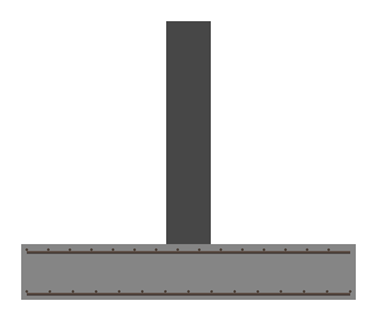
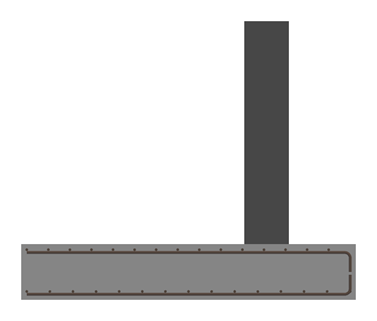
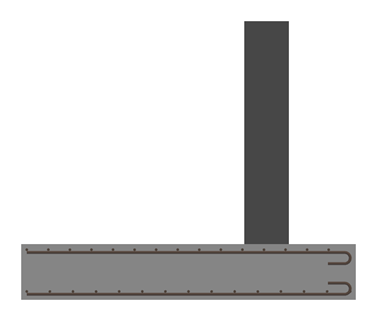
Anchorage length is a fundamental aspect of reinforced concrete design, ensuring that forces in the reinforcement can be safely transferred into the surrounding concrete without bond failure. While often simplified in manual calculations to conservative "rule of thumb" values (e.g., 40 ϕ), this approach can lead to congestion and uneconomical detailing.
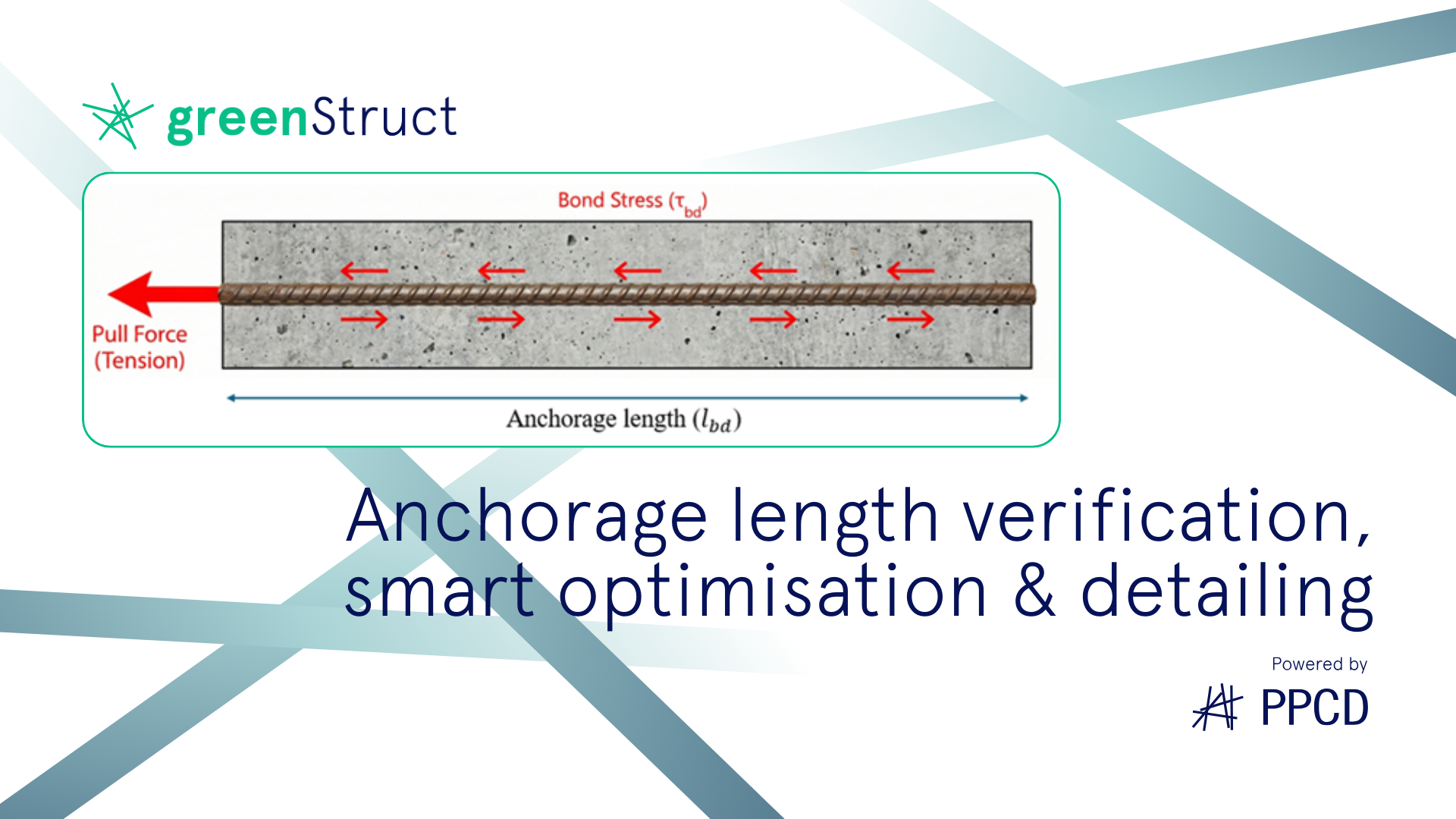
Anchorage length is a fundamental aspect of reinforced concrete design, ensuring that forces in the reinforcement can be safely transferred into the surrounding concrete without bond failure. While often simplified in manual calculations to conservative "rule of thumb" values (e.g., 40$\phi$), this approach can lead to congestion and uneconomical detailing.
greenPad moves beyond these simplifications. By harnessing the computational power of the software, engineers can rigorously evaluate the actual stress demand and geometric constraints of the footing. This provides a smarter, leaner way to handle detailing, automatically checking physical fits and identifying collisions that manual calculations often miss.
But when does anchorage actually become critical? For large, centrically loaded foundations, the bar typically extends well beyond the required anchorage length, making this check trivial. However, for compact footings, edge columns, or foundations with significant moment, the available length from the column face to the pad edge may be insufficient. This is where smart anchorage verification becomes essential. Let's start by understanding what anchorage length actually means.
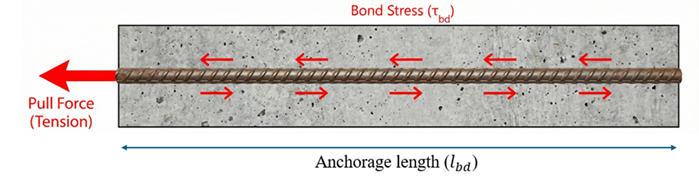
The anchorage length, $l_{bd},$ is the length of reinforcement required to develop a specific stress in the bar through bond with the concrete. If the embedded length is insufficient, the bar may pull out before reaching its design strength, leading to structural failure.
Eurocode 2 (Clause 8.4) defines the design anchorage length $l_{bd}$ as:
Where:
The basic length depends heavily on the bond strength, $f_{bd},$ and the design stress in the bar, $\sigma_{sd}$:
The bond strength is calculated as:
The minimum anchorage length provides a baseline safety margin:
These formulas reveal an important insight: anchorage length is directly proportional to the design stress $\sigma_{sd}$. Traditional calculations conservatively assume full yield stress ($f_{yd}$), but what if the bar isn't fully stressed? This is where greenPad's optimization begins.
Standard software often assumes the reinforcement is stressed to its full yield strength $(f_{yd})$. However, in many pad foundations, the provided reinforcement $(A_{s,prov}),$ exceeds the required reinforcement $(A_{s,req}),$ due to minimum spacing rules or standard bar sizes. This means the actual stress is lower than assumed.
greenPad utilises an intelligent stress optimization algorithm to calculate the actual stress in the bar ($\sigma_{sd}$), rather than assuming full yield. The software evaluates four different stress states and selects the most accurate (lowest valid) value:
As shown in Figure 2, the software runs a concurrent analysis of four models. In this example (footing: $3.0\ m \times 3.0\ m \times 0.6\ m$, load: $M_{Ed} = 125$ kNm, Reinforcement: $16\phi\ @\ 200\ mm$ c/c,$\ A_{s,prov} = 1005$ mm$^{2}$/m, materials: C30/37, S550) greenPad identifies that the "Moment Utilization" method is valid, reducing the design stress from the yield assumption (458 MPa) to the actual demand (217 MPa), a 50% reduction.
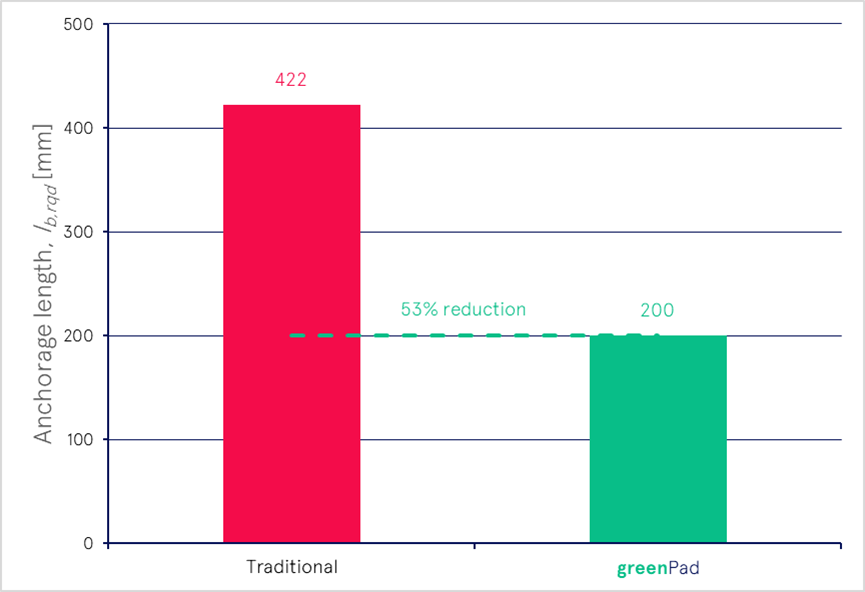
Since anchorage length is directly proportional to stress ($l_{b,rqd}$ = $\phi$ /4 · $\sigma_{sd}$/$f_{bd}$), this 50% stress reduction translates directly to 50% shorter anchorage, as shown in Figure 3.
A 50% reduction in required anchorage length is significant, but calculating a shorter length is only useful if the bar physically fits within the concrete section. What happens when even the optimized length exceeds the available space? greenPad performs rigorous geometric checks to answer this question.
Calculating the required length is only half the battle; the bar must also physically fit within the concrete section. greenPad performs rigorous checks on the geometry and local bond conditions to optimize the Eurocode $\alpha$ coefficients:
The coefficient α₂ ranges from 0.7 to 1.0, with closely spaced bars receiving less favourable (higher) values to ensure safety against splitting failures.
If the footing is too shallow to accommodate the bend radius, greenPad flags this as a failure, preventing impossible detailing instructions from reaching the construction site.
These geometric checks ensure buildability, but they raise a fundamental question: why do we need full anchorage at the edge at all? If the bending moment is zero at the free edge, shouldn't the bar stress also be zero? The answer lies in understanding how forces actually flow through a foundation, and it's not as simple as beam theory suggests.
It is a common misconception in simplified beam design that reinforcement anchorage is not critical at the free edge of a footing because the bending moment is theoretically zero.
However, recent academic work on plasticity models for strip foundations (Hagsten, 2025) demonstrates that the internal flow of forces follows a "fan-shaped" stress field. These inclined compressive struts create horizontal tie forces in the bottom reinforcement that extend to the foundation edges. Unlike simplified elastic beam theory, which assumes zero moment (and therefore zero stress) at free edges, the strut-and-tie model shows that tie forces exist throughout the reinforcement length, particularly in centred or lightly eccentric footings where both edges require verification.
greenPad implements this check by limiting the required anchorage length to half the available projection distance ($l_{bd}$ ≤ a/2), rigorously verifying anchorage geometry at bar extremities. This ensures the foundation can sustain complex internal force flows from the fan-shaped stress field, maintaining strut-and-tie equilibrium where simplified elastic models might overlook the risk. Combined with stress optimization (reducing $\sigma_{sd}$ from $f_{yd}$ to actual demand), this dual approach enables shorter anchorage lengths while maintaining full code compliance and structural safety.
If the footing is too shallow to accommodate the bend radius, greenPad flags this as a failure, preventing impossible detailing instructions from reaching the construction site.
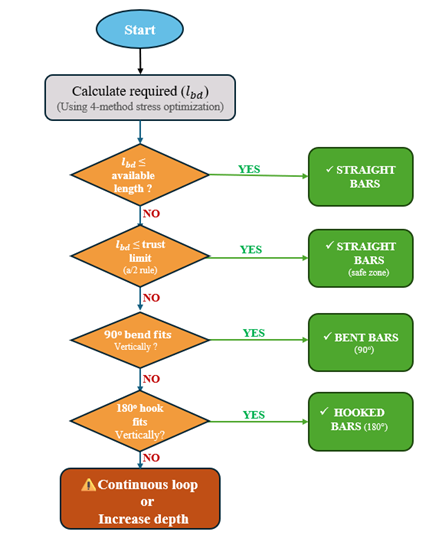
Figure 5: Decision flowchart for automatic bar shape selection based on available length, trust limits (a/2 rule), and vertical fit constraints.
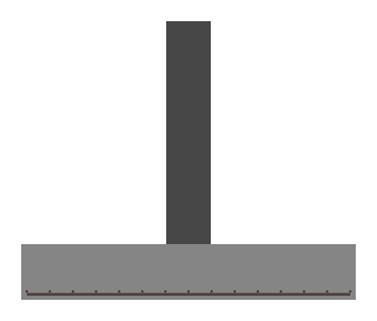
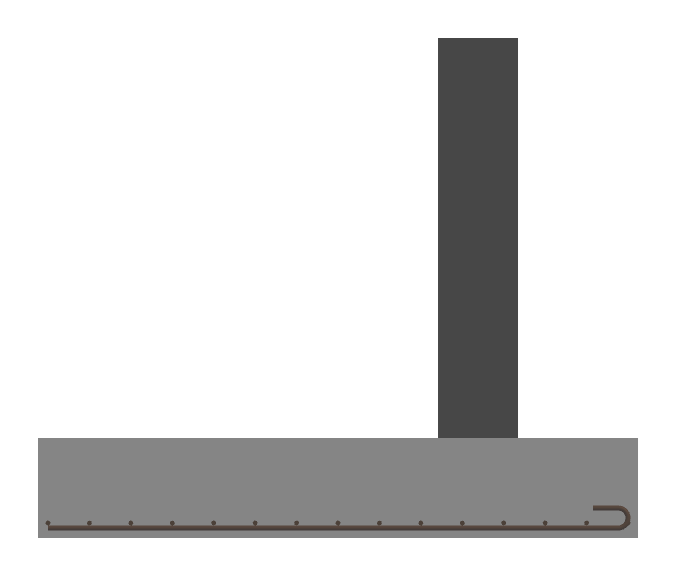
A common issue in thick pad foundations involves the clash between the up-turned legs of bottom reinforcement and the down-turned legs of top reinforcement. As shown in Figure 6, when both layers use bend or hooked configurations, the vertical legs extend into the slab core from opposite directions, creating a potential collision zone.
greenPad introduces a Collision risk analysis feature. It calculates the "intrusion" of top and bottom bends into the core of the slab.
Where leg length depends on the bend type (90° or 180°) and mandrel requirements.
The software provides actionable recommendations, such as suggesting continuous U-bars or loops to eliminate conflicting bends.
Figure 6 illustrates the three anchorage configurations that greenPad evaluates. When top reinforcement is required, the interaction between layers becomes critical, as both bottom (bending up) and top (bending down) reinforcement appear for each configuration. Notice how the bend legs extend into the slab depth. This is where collisions can occur. The software progresses through these options in order of simplicity: straight bars require no additional detailing, 90° bends add moderate complexity, and 180° hooks are used only when necessary. But what happens when both top and bottom reinforcement require bends?
From stress optimization to geometric fitting to collision detection to anchorage verification involves far more than a single formula. Let's summarize the complete picture.
Anchorage verification is more than just a formula; it is a check of geometric feasibility and structural integrity. A reliable design must account for the actual stress state, the physical space available for bends, and the interaction between reinforcement layers.
greenPad automates these complex steps consistently and transparently. By optimizing stress demands, enforcing spacing rules like the a/2 check, and verifying geometric fits, it ensures that designs are not only safe and code-compliant but also buildable and efficient
1. Eurocode 2: Design of concrete structures - Part 1-1: General rules and rules for buildings, EN 1992-1-1, European Committee for Standardization (CEN), 2004.
2. Hagsten, L.G.: Model for bæreevne, spændingsfordeling og forankringskrav i tværarmerede stribefundamenter (Model for load-bearing capacity, stress distribution and anchorage requirements in transverse reinforced strip foundations), Proceedings of the Danish Society for Structural Science and Engineering, Vol. 95, No. 1, 2025.